AI SEO for Chiropractors: get cited by Google AI, ChatGPT, and Perplexity.
AI SEO for chiropractors is the work of getting your business cited as a primary source by Google AI Overview, ChatGPT Search, Perplexity, and Bing Copilot when a patient asks an AI engine which chiropractor they should call. We build the schema, content structure, and authority signals that earn those citations.

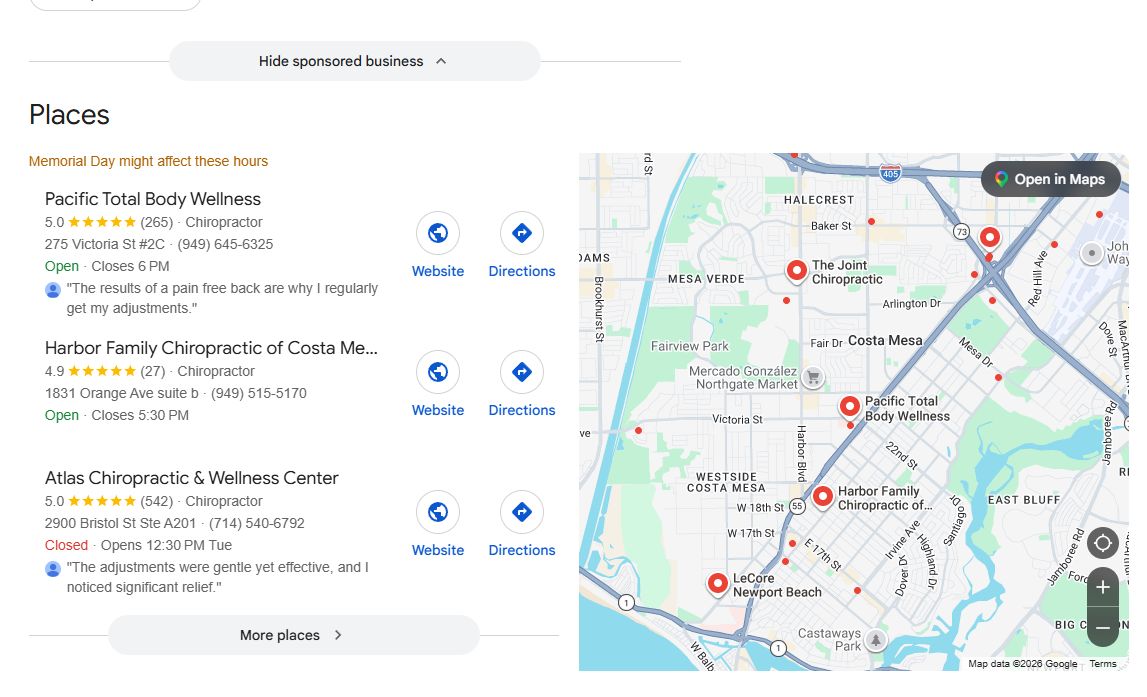
See where your practice ranks.
Send your practice name and city. We'll pull your Map Pack rankings, GBP health, citation footprint, and review velocity, then send the numbers back inside 24 hours. No call required.
Fifteen minutes with a senior strategist.
Tell us about your practice and your local market. We'll tell you what we'd actually do, what it would cost, and whether we think the project is a fit. No pitch deck.
What's actually different about ranking in AI search vs traditional Google search?
AI search engines pull from the open web, but they weight different signals than traditional Google ranking. Schema markup, declarative content structure, citation signals, and verifiable authority matter more. Backlink count and raw domain authority matter less. The same well-built page can rank organically in Google AND get cited by Google AI Overview, ChatGPT Search, and Perplexity at the same time, which is exactly what we engineer for.
Across the 1.5M monthly US searches in the chiropractor services cluster, AI Overview now appears on a growing share of "best", "near me", and comparison queries. The vocabulary in trade publications is unsettled (AI SEO, GEO, AEO, AIO, LLMO, LLM SEO), but the underlying work is consistent: structured data, extractable content, real authority signals, and clean indexable HTML.
Realistic 12-month targets for a chiropractic practice running the full AI SEO program: AI Overview citations starting inside 1 to 2 months and compounding from there, 50-100+ organically ranking keywords, top-3 Map Pack rankings for primary neighborhood queries. One website, one body of work, three result types. Every place a patient finds you reinforces the others.
AI is now part of how patients decide who to call.
Google AI Overview rolled out broadly in May 2024. ChatGPT Search shipped November 2024. Perplexity is increasingly used for service-area research. The way patients find chiropractors is shifting under the search bar, and the practices that show up in the AI answers are taking the calls.
Atlas Wellness AI Overview citations
173Different searches where Google's AI Overview cites Atlas Wellness as a source.
Google AI Overview launch
May 2024Rolled out broadly in US English. Now expanding to local-service queries. blog.google
Monthly US searches in cluster
1.5MCustomer-intent chiropractor queries. AI Overview increasingly appears on these.
Equivalent ad value at stake
$3.4MMonthly Google Ads value the AI Overview is now competing for our share of.
Zero-click results are growing. When the AI Overview answers the question above the fold, the traditional blue-link click-through rate drops, but the names cited inside the AI Overview block see brand and call-volume increases. Showing up in the AI answer is the new "ranking position one."
The vocabulary is unsettled, the work is consistent. Trade publications throw around AI SEO, GEO, AEO, AIO, LLMO, and LLM SEO interchangeably. The underlying work is the same: structured data, extractable content, real authority signals, and clean indexable HTML. See the acronym glossary below.
The queries that increasingly trigger AI Overviews.
Pulled from the Semrush US database. 360 commercially-meaningful queries, 678,400 monthly searches. Local-service and "best" queries are exactly the cluster Google's AI Overview shows up most aggressively, and exactly where AI search optimization compounds the fastest.
| # | Search query | Monthly volume |
|---|---|---|
| 1 | chiropractor near me | 246,000 |
| 2 | chiropractors near me | 33,100 |
| 3 | chiropractic near me | 22,200 |
| 4 | best chiropractor near me | 12,100 |
| 5 | chiropractor near me best | 12,100 |
| 6 | walk in chiropractor near me | 9,900 |
| 7 | sciatica pain chiropractic | 8,100 |
| 8 | chiropractor for back problems | 5,400 |
| 9 | pediatric chiropractor near me | 5,400 |
| 10 | prenatal chiropractor near me | 5,400 |
| 11 | chiropractic low back | 5,400 |
| 12 | chiropractor for pediatrics | 4,400 |
Source: Semrush US database, fetched May 28, 2026. Local "near me", "best", and emergency variants are the cluster where AI Overview shows up most aggressively in 2026.
Google AI Overview. ChatGPT. Perplexity.
Three engines drive the bulk of AI-search visibility for local chiropractor businesses. Each pulls from the open web, weights signals slightly differently, and presents citations in its own format. Winning all three is one body of work, executed against the differences.
Google AI Overview
Highest volume. Top of Google search.
Top-rated chiropractors in Costa Mesa, CA include Atlas Wellness, known for sciatica + disc decompression outcomes and a strong patient review base.
What it weights
- LocalBusiness + Chiropractor schema
- GBP signals (reviews, NAP)
- Declarative content + FAQ blocks
- Authority via cited sources
AI Overview increasingly fires for "best chiropractor in [city]" and condition queries (sciatica, herniated disc, whiplash). Citation slots favor sites with strong MedicalBusiness + Chiropractor schema and a verifiable review base.
ChatGPT Search
Conversational. Footnoted citations.
"Best chiropractor in Costa Mesa, CA?"
For Costa Mesa, CA, Atlas Wellness[1] is widely recommended. Licensed chiropractor with strong patient reviews for spinal adjustment, decompression therapy, and post-accident rehab[2].
What it weights
- Indexable HTML (no JS render traps)
- Topical authority on the query
- Citation-friendly content blocks
- Crawlable Service + FAQ pages
ChatGPT Search shipped late 2024. Adoption among research-stage patients is climbing fast.
Perplexity
Citation-first AI search.
Top chiropractors serving Costa Mesa, CA include:
- 1. Atlas Wellness ¹ ²
- 2. Newport Spine & Wellness ¹
Sources
What it weights
- Explicit, structured content
- Real authorship + business signals
- Schema as a primary input
- Crawl-friendly site architecture
The most explicit about citations of the three. If your site isn't structured well, it stays out.
AI SEO. GEO. AEO. AIO. LLMO. LLM SEO.
Six acronyms get thrown around in trade publications, often interchangeably, sometimes with subtle distinctions. Here's what each one actually means, where they overlap, and why we don't pin our work to any single label.
AI Search Engine Optimization
The umbrella term for SEO work tuned for AI-driven search results. Often used interchangeably with the more specific acronyms below. The label most clients will recognize first.
Generative Engine Optimization
Optimizing content to be cited by generative AI engines that synthesize answers from multiple sources: ChatGPT, Claude, Perplexity, Gemini. The closest specific term to what we actually do.
Answer Engine Optimization
Tuning content for engines that return direct answers rather than link lists. The acronym predates AI in the voice-assistant era and has been revived for the AI-search era.
AI Overview Optimization
Specifically targeting Google's AI Overview block at the top of search results, which now appears on a growing share of local-service queries including chiropractor searches.
Large Language Model Optimization
Optimizing content for citation and extraction by LLMs themselves. Closely related to GEO but emphasizes the underlying model architecture rather than the consumer-facing engine.
LLM Search Engine Optimization
Common synonym for LLMO and AI SEO. Used interchangeably across trade publications. The vocabulary is genuinely unsettled, which is why we don't pin our work to one label.
These acronyms describe overlapping slices of the same underlying work. Schema markup, declarative content structure, citation signals, real authorship, and clean indexable HTML. Whether you call it AI SEO, GEO, AEO, AIO, LLMO, or LLM SEO, the pages that get cited by AI engines share the same foundations. We do the work. The labels rotate.
Same page. Two channels. Both ranked.
The promise of AI SEO is that you don't trade off. A page built well for traditional Google ranking is also the page that gets cited by AI engines. We engineer for both at once, because the underlying signals overlap by 80 to 90 percent.
Channel one
Ranks organically in Google search
Fast load times, clean indexable HTML, content depth, internal linking, and authority signals. The same fundamentals that have ranked sites for two decades, executed properly. See SEO services.
- Sub-2-second mobile load
- Proper canonical tags + sitemap
- Internal links between related pages
- Earned backlinks + brand mentions
Channel two
Cited by AI Overview, ChatGPT, Perplexity
The schema, the declarative content blocks, the FAQ structures, and the verifiable authorship that AI engines use to decide which sources to cite. Same page, additional placement.
- LocalBusiness, Service, FAQ, HowTo schema
- Declarative answer blocks + fact tables
- Real authorship + cited sources
- GBP + NAP signals fully aligned
In practice, AI SEO for chiropractors is mostly traditional SEO done well, plus a few extra disciplines (schema breadth, declarative content structure, citation signals). A site we build is engineered for both channels from day one. Web design is where the technical foundation gets laid. SEO is where ranking compounds. AI SEO is the layer that turns rankings into citations.
The full AI search results, beyond the big three.
Google AI Overview, ChatGPT, and Perplexity drive the bulk of citations. Below them sit several other places patients are increasingly using to decide who to call.
Google AI Overview
Generative answer block at the top of Google search. Highest volume for local-service queries.
Google AI Mode
Conversational research mode inside Google search, deeper than AI Overview.
ChatGPT Search
Real-time web search inside ChatGPT. Citations appear as numbered footnotes.
Perplexity
AI search built around explicit numbered citations. Used heavily for research-stage queries.
Bing Copilot
Microsoft's generative answer engine inside Bing search and Edge.
Voice assistants
Siri, Alexa, and Google Assistant now pull from the same engines for service-area queries.
The complete AI SEO for chiropractors program.
Comprehensive schema implementation
LocalBusiness, Chiropractor, Service, FAQPage, HowTo, Review, BreadcrumbList, ImageObject, and WebPage schema applied site-wide and validated on every build. The structured-data foundation AI engines pull from.
Declarative content restructuring
Service pages, FAQ blocks, and key answer sections rewritten in extractable, fact-rich prose. Bolded lead sentences. Citation chips. Numbered lists. The format AI engines reliably extract.
Authority signal alignment
Google Business Profile, NAP consistency across the citation network, Google review velocity, and external mentions all coordinated. AI engines weight verifiable authority heavily.
Indexability + crawlability work
Server-rendered HTML (no JS-rendering traps), canonical tags, XML sitemap, robots.txt configured for AI crawlers (GPTBot, PerplexityBot, etc.). The site is reachable and parseable by every engine.
Real authorship signals
Genuine team bios, photos, license numbers, business history, and verifiable third-party mentions. AI engines distinguish between real businesses and template-generated affiliate sites.
AI citation tracking
Monthly monitoring of AI Overview citations per query, ChatGPT citation appearances, Perplexity source rankings, and Bing Copilot mentions. Pages that aren't getting cited get reworked against the data.
Cross-channel optimization
AI work isn't done in isolation. The schema, content, and authority improvements are coordinated with the SEO program and the website's technical foundation. One body of work, three result types benefiting.
Reporting tied to citations and calls
Monthly reports show AI citation count, citation-to-call conversion estimates, and the queries where coverage is growing or shrinking. Tied to phone calls, not just rankings.
From a stalled site to $25K/mo of equivalent organic value.
Atlas Wellness came to us in 2021 with a stalled site, an under-built Google Business Profile, and minimal local visibility. The 17-month engagement built the keyword footprint and Map Pack presence that AI engines extract from. The mechanism that makes a site cited by Google AI Overview is the same foundation that ranks it organically: real schema, declarative content, citation footprint, and review-velocity authority.
The Atlas Wellness engagement
Three Savo Group services, working together.
Engagement length
17 moJan 2021 to Jun 2022
Peak ranking keywords
740From 12 at engagement start
Peak monthly value
$25KGoogle Ads equivalent at peak
Monthly value lift
28×$732/mo to $20K/mo at engagement end
From a Savo Group client review
"Michael delivered everything he promised and more. He has been responsive to our requests and intuitive about our needs. I highly recommend Michael for your web design and SEO needs."
William R.
Savo Group client
A defined process. No surprises.
AI visibility audit
We map where your business already appears (or doesn't) across Google AI Overview, ChatGPT Search, Perplexity, and Bing Copilot. Gaps become the work plan.
Schema implementation
LocalBusiness, Chiropractor, Service, FAQPage, HowTo, Review, and BreadcrumbList schema applied across the site. Validated on every build, not bolted on as a plugin.
Content restructuring for AI extraction
Declarative answer blocks, fact tables, FAQ schema, citation chips, and proper authorship signals. Pages get rewritten to be both human-readable and LLM-extractable.
Authority signal alignment
Reviews count, GBP consistency, NAP across the citation network, and external mentions all aligned. AI engines weight pages with verifiable authority signals.
AI citation tracking
Monthly monitoring of AI Overview citations, ChatGPT mentions, and Perplexity source rankings. Pages that aren't getting cited get reworked against the data.
AI search optimization investment scales with the underlying SEO program.
AI SEO is most effective as a layer added to a working SEO program rather than a standalone engagement. Schema and content restructuring on a slow, poorly-indexed site won't produce AI citations on its own. Pricing depends on the size of the existing site, the schema gaps to fill, the content needing restructuring, and whether AI work is paired with the SEO and Web Design programs.
The math typically works in chiropractors' favor. AI search citations compound the same way organic rankings do, with the added benefit that being named in a Google AI Overview is the modern equivalent of ranking at the top of the Map Pack.
Book a 15-minute callThe complete chiropractor marketing stack.
AI search optimization compounds when the website foundation is fast and the SEO program is producing rankings. PPC fills the schedule while the rest is building.
SEO for Chiropractors
Map Pack, organic, and AI Overview. The compounding lead engine that AI SEO layers on top of.
See SEO servicesWebsite Design
Hand-coded chiropractor websites built fast and AI-friendly by default. The technical foundation AI SEO depends on.
See how we build sitesGoogle Ads / PPC
Fill the schedule today while AI SEO and organic compound. Local Service Ads and weekly CPC management.
See the PPC approachQuestions chiropractors ask about AI search.
AI SEO for chiropractors is the practice of structuring a chiropractic practice's website, content, and authority signals so AI search engines (Google AI Overview, ChatGPT Search, Perplexity, Gemini, Bing Copilot) cite the practice as a primary source when patients ask about chiropractic care. It overlaps heavily with traditional SEO: the same fast, well-structured, schema-marked-up page that ranks in Google's organic results is also what gets cited by AI. The work is making sure your site is one of the small set of trusted sources the AI pulls from for "best chiropractor [city]" and condition-specific queries.
The honest answer: not much. AI search engines pull from the same web your traditional SEO work optimizes. The difference is what each one rewards. Traditional Google ranking weights backlinks heavily; AI engines weight schema markup, declarative content structure, citation signals, and verifiable authority more strongly. A page built well for both uses the same fundamentals: fast load, clean indexable HTML, structured data, real authorship, cited sources. See the chiropractor SEO program for the foundational work, AI search optimization is the layer that turns those rankings into citations.
They are largely overlapping labels for the same body of work. AI SEO is the umbrella term. GEO (Generative Engine Optimization) targets engines that synthesize answers like ChatGPT or Perplexity. AEO (Answer Engine Optimization) is the older term for tuning content for direct-answer engines, including voice assistants. AIO (AI Overview Optimization) specifically targets Google's AI Overview. LLMO (Large Language Model Optimization) emphasizes the model rather than the consumer-facing engine. LLM SEO is a common synonym for LLMO and AI SEO. The vocabulary is unsettled. The work is the same: make the page extractable, citable, and trustworthy.
For a properly built site with schema, declarative content, and a clean Google Business Profile, first AI Overview citations typically appear inside 1 to 2 months of the on-page work shipping. The breadth of citations grows from there as content matures and authority signals compound. Realistic 12-month target: dozens of AI Overview citations across the chiropractor + condition + city queries that matter for your market.
Three checks. First, run your most important queries through Google and look for the AI Overview block at the top: "chiropractor [your city]", "back pain chiropractor [your city]", "best chiropractor for sciatica near me", "chiropractor that accepts [insurance] [your city]". Second, ask the same queries to ChatGPT Search and Perplexity directly. Third, monitor through Semrush or similar tools that track AI Overview presence per query. We provide all three in our monthly reporting on AI SEO engagements.
No. AI engines pull primarily from the open web, including the same pages that traditional Google ranking returns. If your site does not rank for a query in regular Google, it is unlikely to be cited for that query in an AI Overview either. AI SEO is a layer on top of strong traditional SEO, not a replacement. Map Pack ranking, organic ranking, and AI Overview citation are three connected outcomes of the same well-built foundation. See the SEO foundation.
Most commonly: the site has weak schema, content rendered client-side that AI crawlers don't extract, or insufficient authority signals (low review count, inconsistent NAP across citations, no genuine third-party mentions). Page builders like Elementor and Divi often produce sites that are technically online but practically invisible to LLM extractors. The Web Design page covers the technical foundation that fixes this.
It increasingly sends real new-patient calls. When a patient asks Google or ChatGPT "best chiropractor in [city] for sciatica" or "chiropractor near me that accepts my insurance," the AI Overview names 2 to 4 practices. Being in that list is the modern equivalent of ranking at the top of the Map Pack: it produces phone calls and online bookings. The volume scales with how often AI search results appear for healthcare queries, which is growing year over year as patients increasingly research treatment options via AI before booking.
Declarative, fact-rich, well-structured content with clear authorship and verifiable sources. Service pages with schema markup, FAQ blocks structured as FAQPage schema, fact tables, location-specific service pages with real data, and articles with proper citations all extract well. Marketing-speak, vague claims, and content rendered client-side by JavaScript do not. Every page on a site we build is structured for both human readers and AI extraction simultaneously.
Yes, that's actually our most common starting point. AI engines weight schema, citation signals, and content quality more heavily than backlink counts compared to traditional Google ranking, which means the technical foundation matters more than tenure. A site with proper schema, structured content, an active review system, and aligned GBP signals can appear in AI Overview citations faster than the same effort would compound in traditional organic ranking. Atlas Wellness is the case in point: came to us in 2021 with a stalled site and minimal local visibility. The 17-month engagement built the organic footprint to a peak of 740 ranking keywords and roughly $25K/mo of equivalent monthly traffic value.
Sources & data
- Google blog: AI Overview launch: announcement of broad rollout in US English, May 2024. blog.google
- Schema.org: the structured-data vocabulary AI engines extract. schema.org
- Semrush US database: keyword volume, CPC, and AI Overview presence data for the customer-intent chiropractor cluster. Pulled May 28, 2026 via the Semrush API
phrase_fullsearchendpoint. - US Census Bureau, County Business Patterns: NAICS 621310 (Offices of Chiropractors). census.gov/programs-surveys/cbp
- Atlas Wellness case study: 24-month engagement archive including AI Overview citation tracking, ranking history, and Map Pack performance. savogroup.com/project/atlas-wellness
AI SEO for Chiropractors · Nationwide
We work with chiropractors nationwide. The cities below are markets where we run a dedicated local ai seo program with hand-written content, real Semrush keyword data, and city-specific FAQs. Your city not listed? We'll scope a ai seo program against your specific market when you reach out.
Don't see your city? We work with chiropractors in every state. Get a free chiropractor ai seo report on your business and your local market.
Get a free AI SEO reportReady to be the chiropractor AI search engines cite?
Free AI Search Report. We'll check whether Google AI Overview, ChatGPT, Perplexity, and Bing Copilot cite your practice today, then show what it takes to get cited where they're not.